It started with a simple question: How long does it take to write a blog post? To find the answer, we reached out to 1000 bloggers. We asked a few other questions at the same time, and the responses gave us insight into the business of blogging.
Each year since, we've repeated this research. Over time, the data tells the story of a changing industry.
Welcome to the 4th Annual Blogger Survey.
A multi-year survey is the only way to discover these blogging statistics and trends. Each year, we have new questions, more data, and a few unexpected insights into the changing world of content.
First, a huge thanks to the 1377 bloggers who completed the survey and the experts who contributed their insights. You made this possible. This is your work!
The survey breaks down into 11 questions in three broad categories:
1. Changes In The Blogging Process 2. Trends on Blog Content 3. Blogging Promotion and Measurement
For each question, we'll present the survey data along with analysis showing which types of bloggers are reporting the best results. And finally, we'll share the insights of experts and friends.
Let's jump into the statistics and analysis!
1. Changes in The Blogging Process
This section tracks changes in the process of creating blog content. Here we see the biggest trend in blogging: more effort going into content creation. More time and more resources are going into the typical post.
How long does it take to write a blog post?
In 2014, the average blog post took 2.5 hours to create. That number has increased ever since. Here we chart the increase in the amount of time spent per blog post.
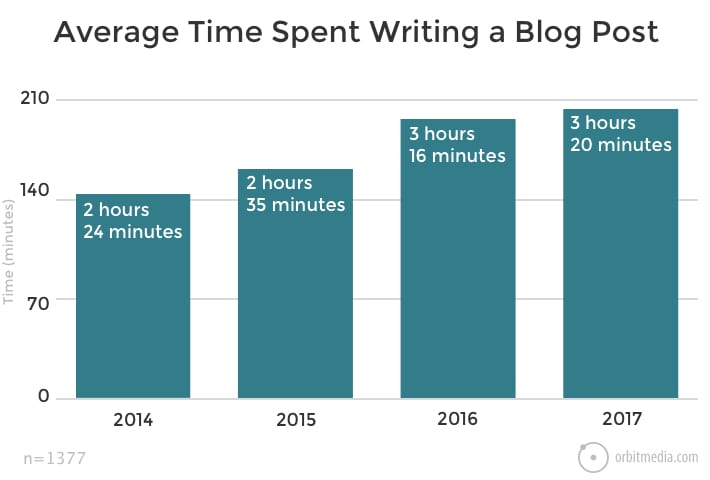
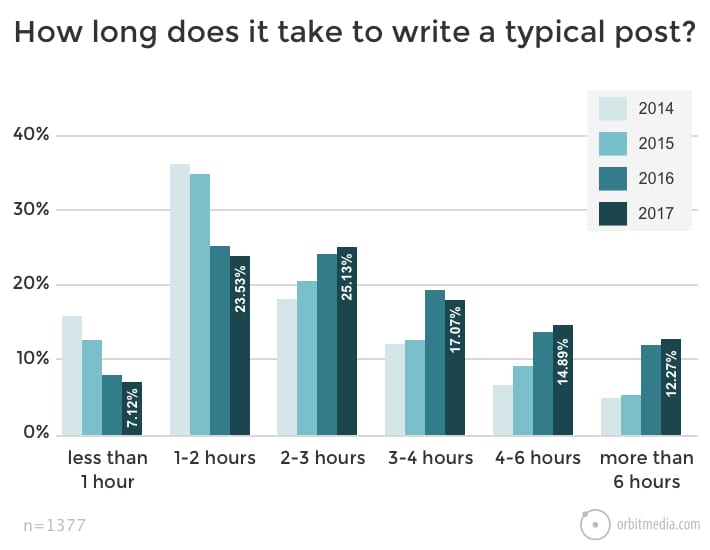
Breaking that number down, you can see a sharp decline in the percentage of bloggers who write posts in less than an hour. And a dramatic rise in the percentage of bloggers who spend 6+ hours on a typical post.
Key findings:
The average blog post takes 3 hours and 20 minutes to write. In 2017, bloggers spent 39% more time on a typical blog post than in 2014 Three years ago, 1 in 20 bloggers spent 6+ hours on a typical blog post.Today that number is 1 in 8. Analysis: Bloggers are working harder, and it's paying off.
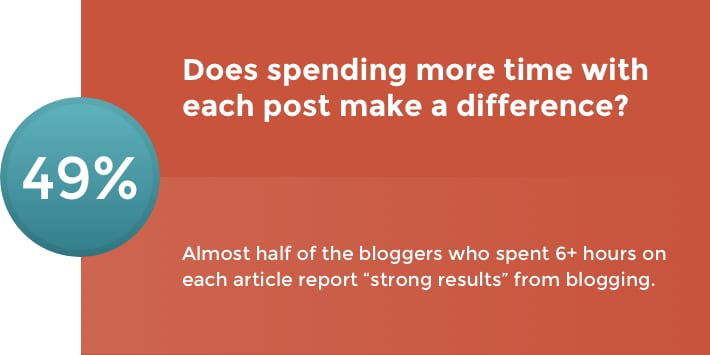
49% of bloggers who spend 6+ hours on each article report "strong results" from blogging. That's a big increase over last year. Those who put the greatest investment into their content see the greatest returns.

Expert insight: Ann Handley, MarketingProfs
"The bigger themes here are two. One: quality matters. And two: We don't need more content. We need more relevant content.
Good writing takes time. Crafting relevance for your audience takes time. Inspired content takes time.
I have yet to meet a writer who can pull something beautiful fully formed out of their head — like Athena out of the head of Zeus.
To me this survey signals that writers are recognizing that less truly is more… it's better to spend the time to create a beautiful one thing than less time creating a bunch of meh."
How frequently do bloggers publish?
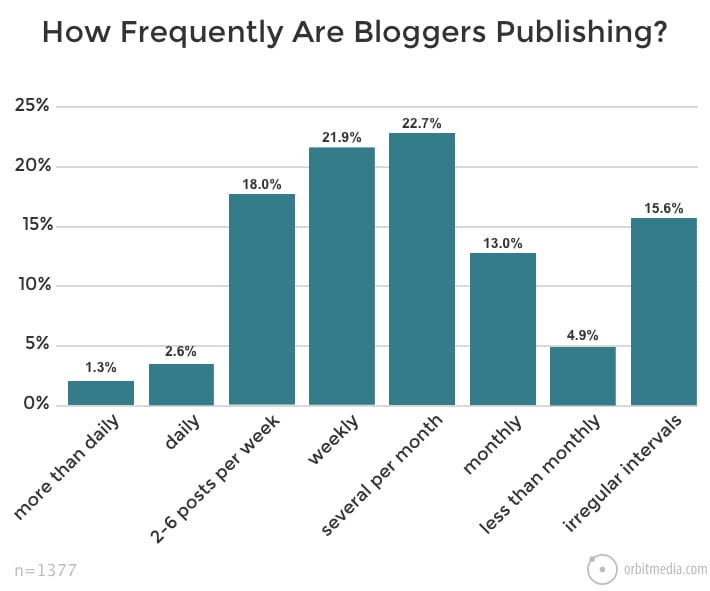
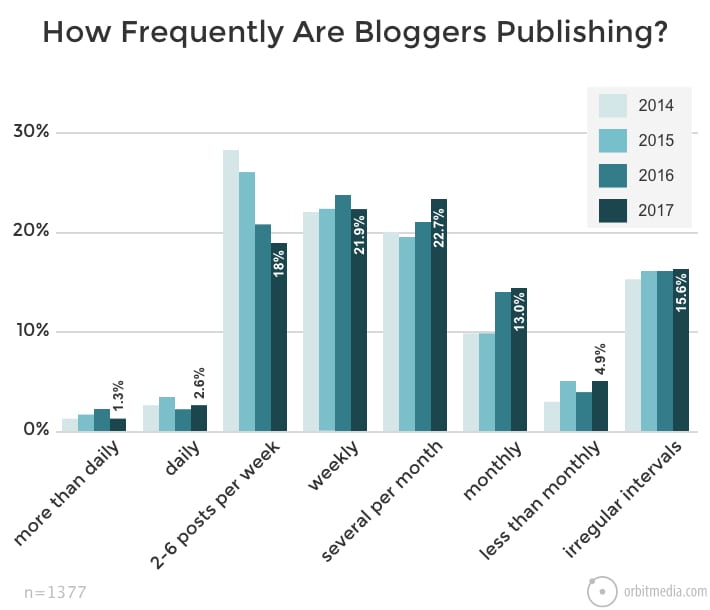
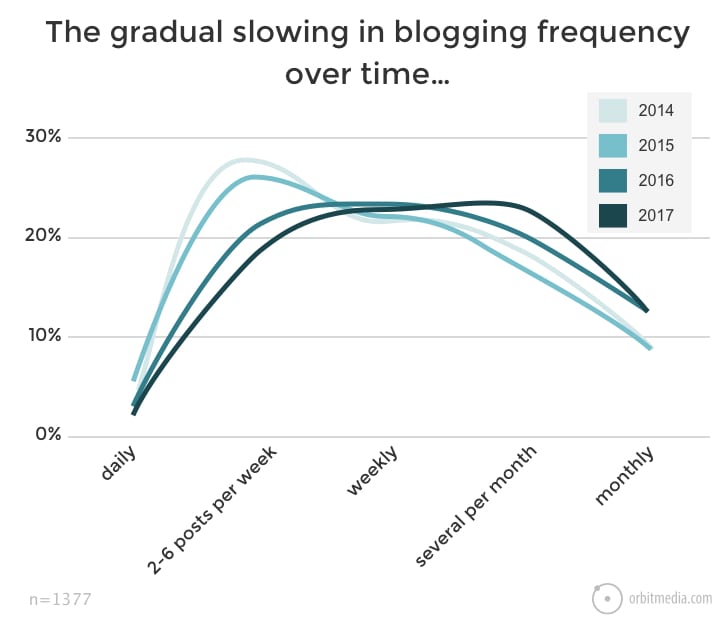
Most bloggers are in the several-per-week to several-per-month range. But the survey shows that as we spend more time on each post, our publishing frequency slows down. A lot of brands are increasing their publishing frequency, but individual bloggers are not.
Here you can see the current breakdown and the trends over time:
Key findings:
Publishing frequency for individual bloggers is down. The most common answer is "several per month." Two years ago it was "2-6 times per week." Daily and monthly are unusual. Most bloggers are somewhere in between. Consistency remains steady! Around 85% of bloggers publish regularly. Analysis: A slight drop in blogging frequency. But higher frequency correlates with better results.
More time is spent on each post but with a slightly reduced frequency. This doesn't settle the debate over quality and quantity, though. Far from it.
When we look at the connection between publishing frequency and bloggers who report strong results, we see that quantity correlates with better results right down the line. Bloggers who publish more often are far more likely to get results.
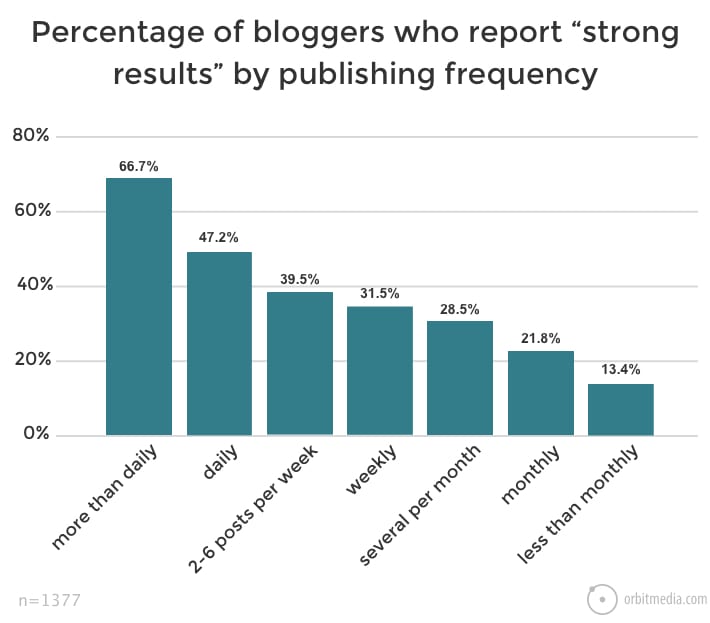
But bloggers who publish frequently are often good at all the related work, such as promoting content and measuring results. These people are dedicated. Who would maintain that kind of output without getting great results?

Expert Insight: Gini Dietrich, Spinsucks.com
"It's not surprising blogging has slowed. On our blog, we've seen comments decrease in favor of 'dark' social media. Combine that with a good majority of bloggers who can't measure results effectively, and you can see how it's easy for blogging to become a slog.
On the flip side, it's good to see that long-form content is continuing to increase [data below]. After 11 years of blogging, I can vouch for longer form content, smart SEO, and consistency as the keys to success. These key findings definitely support that."
Are bloggers using editors?
Originally, blogging was just journaling online. "Logging the web" was shortened to "weblog" in 1997, which became "blog" in 1999 (you can read the history here). It was once very informal, but today a majority of bloggers work with an editor (or at least have someone informally review their work) before hitting the publish button.

Key findings:
In 2017, twice as many bloggers work with editors compared to 2014. About half of all bloggers edit their own work. This hasn't changed much. 1 in 5 bloggers has a formal editing process. Analysis: Editors make a difference.
Editors improve results. Bloggers who have a formal process for edits are 43% more likely to report strong results. This is another example where the data shows bigger payoffs for bigger investment.


Expert Insight: Brian Clark, Copyblogger
"Copyblogger was one of the earliest sites to accept guest posts back in 2006-2007, and I personally edited every submission, just as if it were a traditional magazine (and that's the way I thought of it). Then Sonia Simone joined me and took over that role. And now years later, Stefanie Flaxman edits every article that appears on the site.
In short, it's in the editing that good content becomes excellent. It can be tough to objectively edit your own writing, plus an outside perspective can help your work go to the next level. If you're serious about making a living with your content, you should aim to work with an editor as soon as it's feasible."
Where and when do bloggers write?
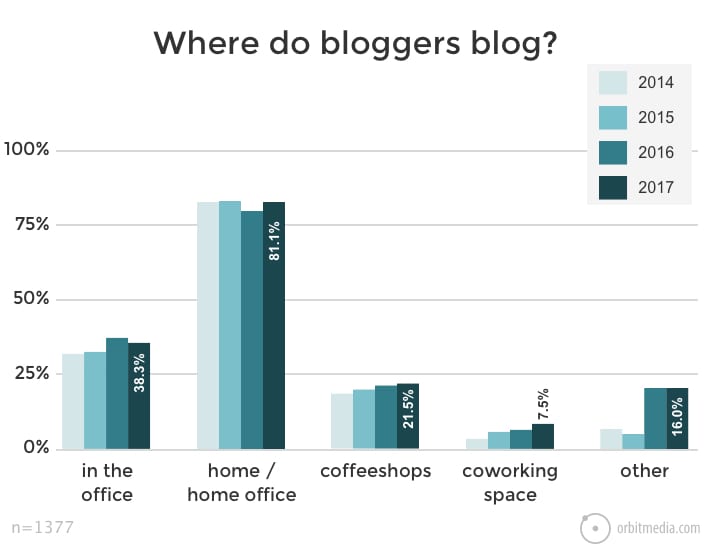
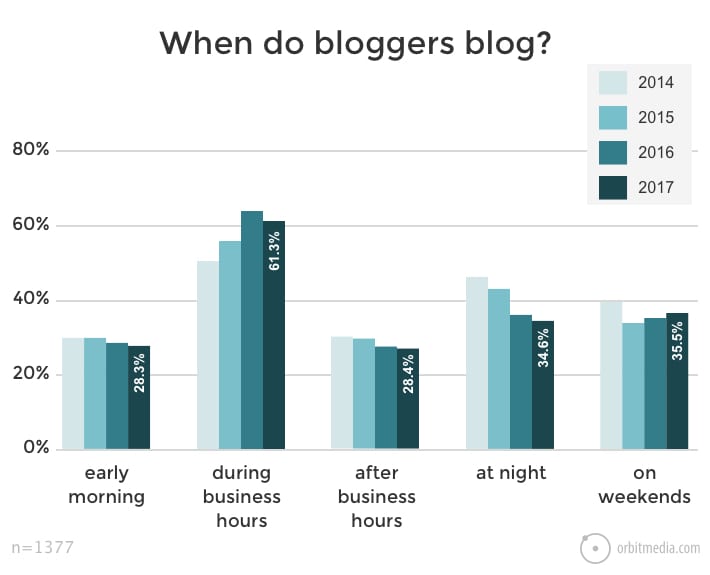
It's portable work. It can be done any time of day from any place. When we ask questions about time and place, we learn that the work is done at all times in all places.
Key findings:
Bloggers are a totally mobile workforce. We work everywhere and all the time. 4 in 5 bloggers take their work home. 1 in 3 bloggers work on nights and on weekends. 
Expert Insight: Heidi Cohen, Actionable Marketing Guide
"Blogging no longer fits the work-in-your-pajamas stereotype. It's evolved into serious business.
But it's also a creative business. It's not surprising that a fifth of respondents create content in coffee shops. They actively seek environments for creativity's sake. One third of respondents blog early in the morning; they use this quiet period for creativity.
Although we aspire to get most of our blogging work done before the evening, we still have more work than we can handle, especially if we're creating 10X content. Personally, I use my mornings for creative content development and try to let it sit overnight before I edit into a polished version the next day."
2. Trends in Blog Content
Here we chart the changes in the content itself. We can see all kinds of blogging statistics and trends in blog post length, media and placement.
How long is your typical blog post?
There's no agreement about the ideal length for content. But the survey tells us the average length.
So how long is the average blog post? Has that changed?
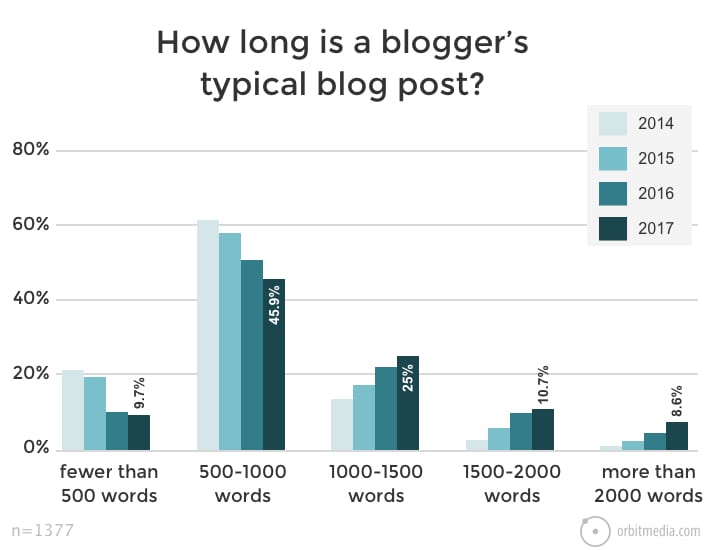
Here the trend is toward longer articles. This is not surprising considering the increased time spent on each article.
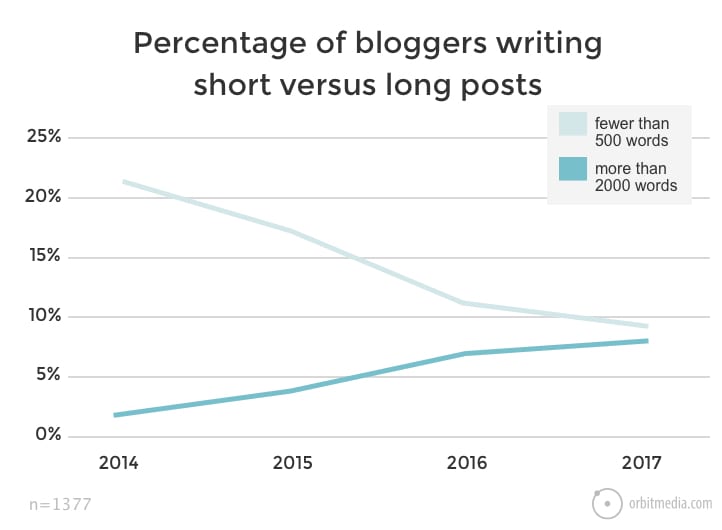
The breakdown shows us that while far fewer bloggers are writing short posts, there is a huge increase in the percentage of bloggers writing longer posts.
After averaging the length in each answer, we can estimate the average length of a blog post and compare it to years past.

Key findings:
The average blog post is 1142 words long. That's 41% more words than the average post three years ago! Half as many bloggers are writing shorties (<500 word posts). Six times as many bloggers are writing long (2000+ word posts). 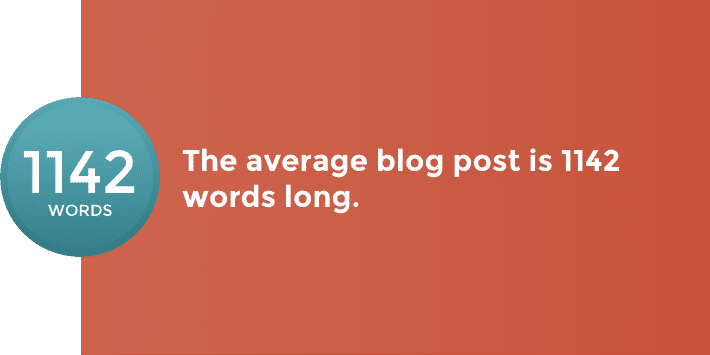
Analysis: Bloggers going big are far more likely to get results.
The difference here is huge. Bloggers who write big posts are twice as likely to report strong results.
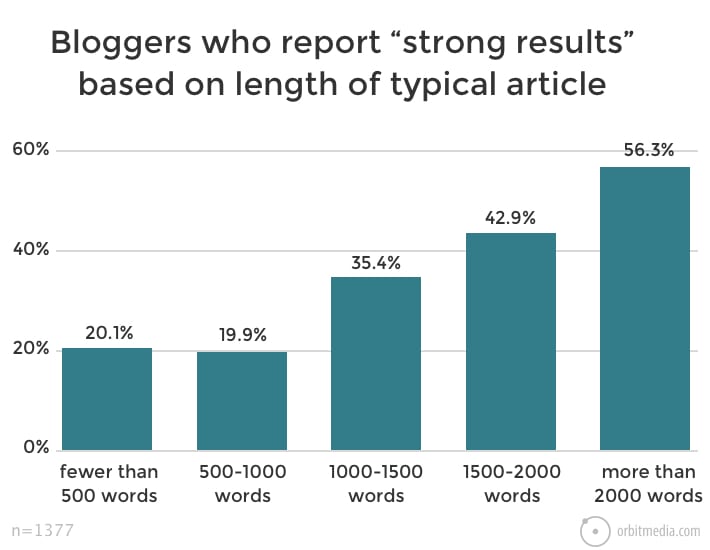
Careful with this data. This doesn't say that long posts are always better. But it does show that greater investment correlates with higher ROI. More bloggers are going deep into the subject matter, answering questions from every angle, and making a sincere effort at producing the best page for the topic.
And they're winning.

Expert Insight: Joe Pulizzi, Content Marketing Institute
"Well, so much for the short attention span of audiences today. When we started the CMI blog back in 2007, we rarely had a post over 1000 words. Today, our posts are getting increasingly longer, some nearing 3000 words. It's not necessarily that longer is better, but our job is to deliver truly useful and complete information to our audience.
Frankly, it doesn't matter how long the articles are to get us to that point, but the trend continues to be more words in each post. In 2007, a blogger could "take off" on a post and not deliver truly remarkable content. Today, you can't afford to miss out on even one article if you want to keep your audience loyal and engaged."
What do bloggers include in their content?
A featured image? More than one? A list?
When we ask what kind of formatting and media bloggers add to a typical post, we begin to see how the shape of posts evolves. Blogging is an increasingly visual medium.

Key findings:
Most bloggers are adding more images. 30% more bloggers are using multiple images compared to years ago. Video is more popular in social media, but not more popular on blogs. Lists are hard to resist. About half all bloggers add bulleted or numbered lists to their content. Analysis: More visuals = better results.
The uptick in visuals is paying off. Content with more images and video gets better results, as reported by the bloggers who use them. Multiple images are better than a single image. Videos are better than pictures.

Here's a surprise: bloggers who use audio in their blog content (presumably podcasts) are the most likely to report strong results. Listen to the data. It's trying to tell us something!

Expert Insight: Ian Cleary, RazorSocial
"My typical blog post contains images and screenshots. I include images that describe the post for social media sharing. But I also add images that describe what I'm talking about. Some people need the visuals to back it up.
Recently I've started a YouTube channel so if there's a relevant video I'll add this in also. I love writing long detailed posts but I need to break this up into smaller sections and visuals/videos help with this."
Is guest posting still a popular practice?
Bylined articles, digital PR, or off-site SEO. Whatever you call it, guest blogging is still a popular practice. More bloggers are pitching to and writing for external blogs. Most bloggers are involved in guest blogging at least sometimes. There is no sign of a decline.


Key findings:
Two-thirds of bloggers do guest posting at least sometimes. Every year, a greater percentage of bloggers are doing at least some guest blogging. Analysis: Guest posting is popular, fun and not always effective.
Results are mixed. There is no correlation between bloggers who guest post and bloggers who get strong results. This may be because results are often indirect and difficult to measure.
The benefits of guest blogging include networking, personal branding, improved writing skills and making new friends. There's also an SEO/linking/authority benefit which is tough to measure. These aren't things that can be quantified.
Let's let a guest blogging pro explain.

Expert Insight: Aaron Orendorff, Founder iconiContent
"Guest posting has never helped drive traffic to my site, build my email list, or sell products. However, guest posting did help build my career as a freelance writer. This happens in two ways. First, authority. Few things engender social proof — and thereby open the door to new clients at higher rates — than a big, beautiful logo bar.
Second, SEO. While most sites give you a default link in your author bio, the 'greatest gift a guest blogger can give themselves' is a link to one of their articles in the body of a post. It's unwise to do this with initial pitches. But once you've established a solid relationship with an editor, it's gold."
Are bloggers updating older articles?
Digital ink is never dry. Often, bringing an older post up-to-date is faster and easier than creating a new post. We've embraced this tactic at Orbit, and we wondered if others are doing it, too. So this year we added the question to the survey. What percentage of bloggers go back and update old content?
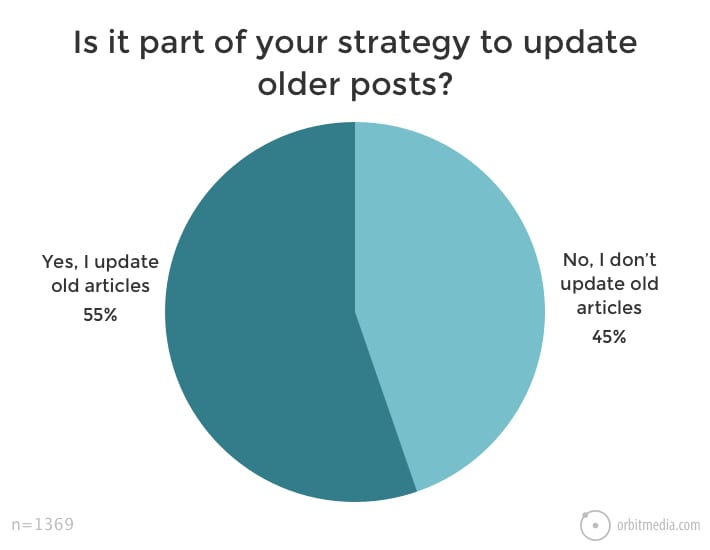
Key finding: Most bloggers are updating old posts at least sometimes. Analysis: Most bloggers go back and make updates.
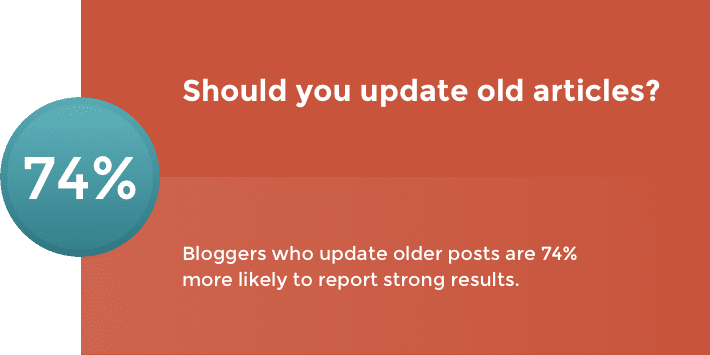
Bloggers are learning that freshening up an old post may be better than writing something new. Bloggers who update older content are 74% more likely to report strong results. As the body of work behind a blogger grows, it's gets easier to look back and find opportunities to update, rewrite and republish.

Expert Insight: Lisa Jenkins, Editor Social Media Examiner
"I've found that it's best to begin with dated articles that continue to bring in high rates of traffic but are now seeing increased bounce rates. Articles that fit this description are often performing well in search and clearly address a pain point for your audience but might not have the up-to-date insight readers are looking for. It's important to remember that while you can update the text and should include a date stamp at the top of the article to show readers when the last update occurred, you should never change the original URL or you'll lose all that search juice."
3. Blogging Promotion and Measurement
It's not the best content that wins. It's the best promoted content that wins. So let's take a look at how bloggers are driving traffic and measuring results.
How is your content typically promoted?
Content promotion is often more important than content quality in driving traffic. How is content promotion changing for bloggers? The data here has some surprises.
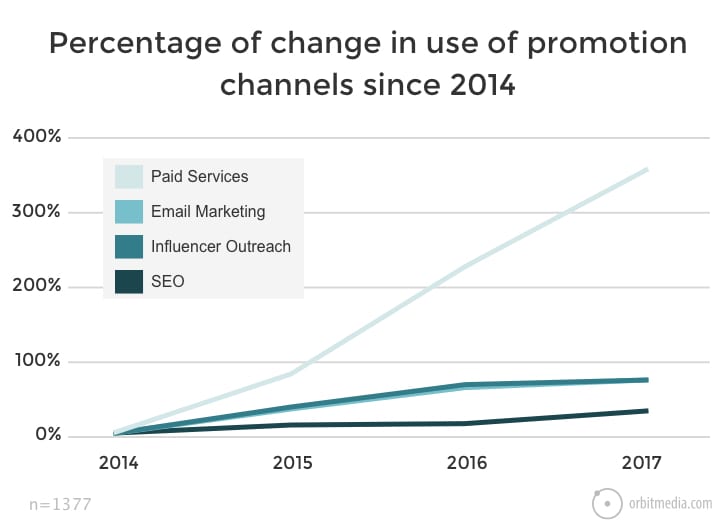
The most dramatic trend in this year's survey: the rise of paid promotion. There are all kinds of ways to promote an article and more bloggers are using more channels. All content promotion tactics are rising in popularity. But bloggers are buying traffic in greater numbers than ever before.
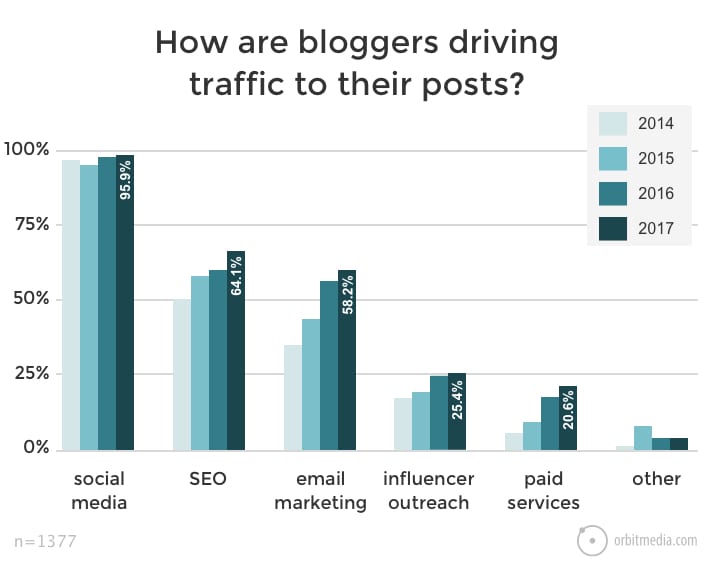
If we remove social media (which is nearly ubiquitous) and plot the other channels from the same starting point, we can see that the relative increase in paid promotion is even more dramatic.
Key findings:
There is almost a 5x increase in paid content promotion since 2014. 1 in 4 bloggers are now collaborating with influencers. Almost two-thirds of bloggers pay attention to SEO. 42% of bloggers are still not using email marketing. Analysis: More difficult (less common) promotion channels are more effective.
Less popular tactics are getting better results. There's an inverse correlation between popularity and effectiveness. That suggests that counter-competitive actions work well.
Harder tactics also get better results. Promoting on social can be as easy as sharing on Facebook. Email marketing and SEO require a bit more work. And getting influencers on board (or pulling out your wallet) can be hard. Here again, we see that greater investment leads to better results.
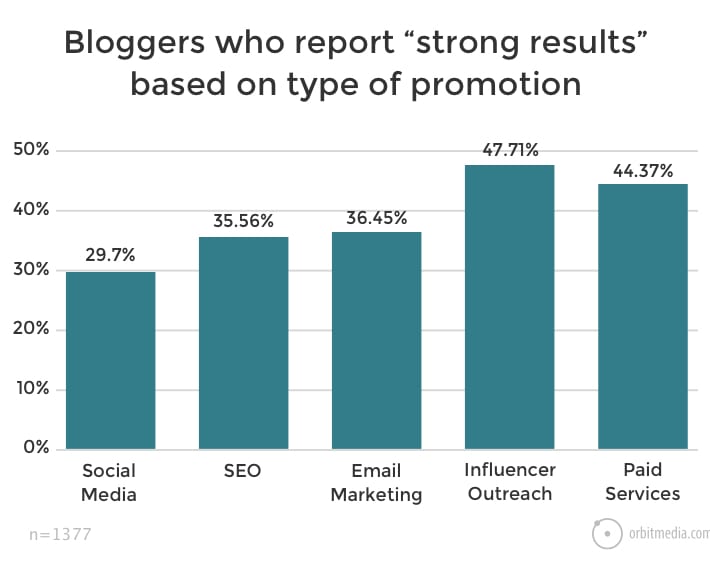
Influencer marketing is winning. Almost half of bloggers who collaborate with influencers report strong results. It works. There are people out there who have already built the audience with which you'd like to connect. Collaboration is a fast, effective way to reach that audience.
Paid is winning. Only 3% of bloggers who use paid promotion reported disappointing results. This might be because paid promotion also provides its own set of reports, helping to justify ROI. At this pace, half of all bloggers will be buying traffic in four years.



Expert Insight: Lee Odden, Top Rank Marketing
"Lowering organic social visibility, elusive SEO, and dramatic increases in competition have created new challenges for marketers using blogs to attract, engage, and retain customers.
Beyond meeting quantitative blog traffic goals is qualitative engagement. More than ever, buyers trust industry experts and peers to engage in meaningful ways. Influencer engagement that goes beyond 'please look at my post' outreach and makes content collaboration part of an ongoing relationship pays dividends."
How often do bloggers check Analytics?
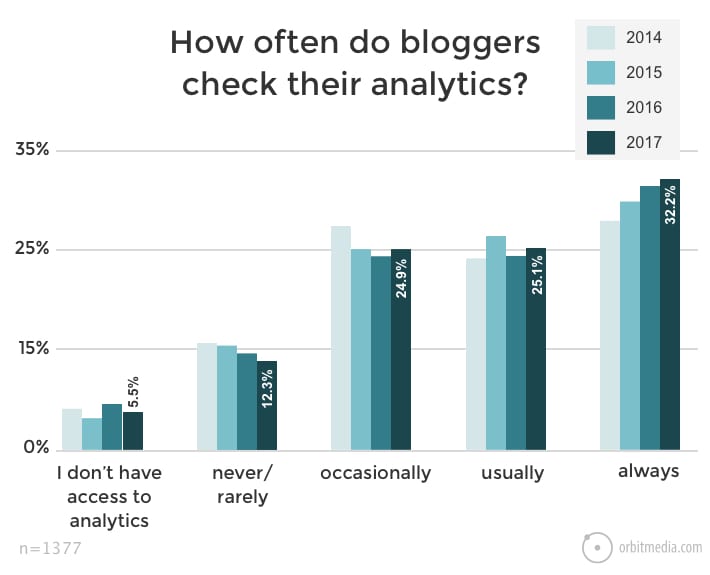
We're happy to report a slight increase here. More bloggers are paying attention to the data. I was hoping for a larger increase, considering the increase in paid promotion. If bloggers buy traffic, they should measure traffic. Right?
Key findings:
Most bloggers check Analytics most of the time. There has been a slight year-to-year increase. 42% of bloggers don't use Analytics or use it only occasionally. 1 in 20 bloggers doesn't even have access to Analytics. Analysis:
Well, if you're not checking Analytics, how would you know if you're getting strong results? So this one isn't surprising. Bloggers who measure results get better results.


Expert Insight: Annie Cushing, Founder Annielytics
"As a blogger, I get the hesitancy to look at data. You pour so much of your heart and soul into your work, and data can be so harsh and unforgiving. I can analyze someone else's site data no problem. But it's difficult to look at my own.
If I see a drop in pretty much anything (sans bounce rate), I feel like the data is telling me my baby is ugly. That said, you can't improve what you can't measure. So we must put on our big girl/boy pants and stare down that data, no matter how insecure and fragile it makes us feel!"
Are bloggers driving results?
For dessert, we are serving a pie chart.
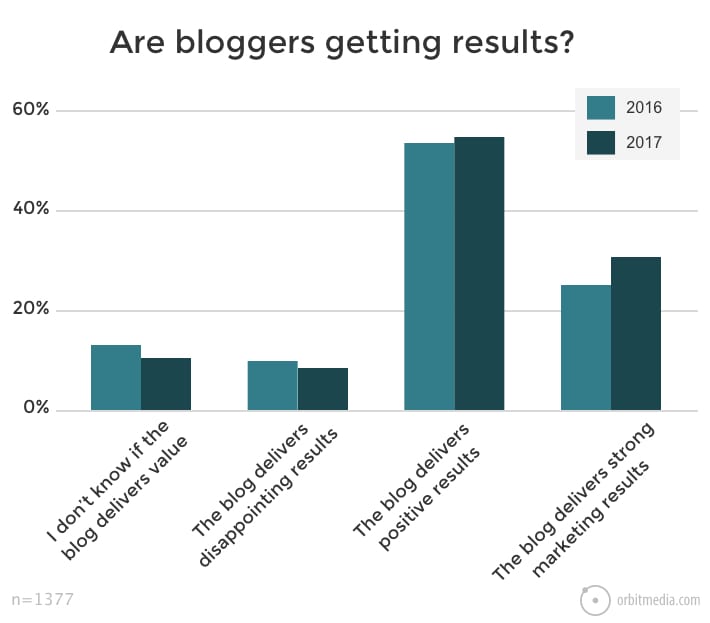
We're ending with some good news. We are spending more time creating content and more money promoting it, and the investment is paying off. Bloggers are reporting stronger results from content marketing.
When asked to report on the effectiveness of their efforts, almost 30% of respondents reported "strong results." The vast majority of bloggers are seeing rewards from their efforts and meeting their goals, whatever they might be.
Less than 1 in 5 bloggers answered "I don't know" or reported disappointing results.

You can see the change since last year. There is a 20% increase in the number of bloggers who report strong results.
Thank you!
We are grateful to everyone who helped with this effort, starting with the 1377 of you who took a minute out of your day to answer the questions. Also, a huge thanks to our contributors, Amanda Gant, Marketing Director Extraordinaire, Jason Quey, our friend and outreach expert, Barry Feldman for his expert input and feedback, Joe Daleo for his pivot table magic and Jantzen Loza for designing the graphics. Thank you all!
Source:
Blogging Statistics and Trends: The 2017 Survey of 1000+ Bloggers


 Ten years ago today we posted our first NIOSH Science Blog, Preventing Fire Fighter Fatalities from Cardiovascular Events. Since then we have posted 433 blogs on a range of topics from A Robot May Not Injure a Worker: Working safely with robots to Preliminary Field Studies on Worker Exposures to Volatile Chemicals during Oil and Gas Extraction Flowback and Production Testing Operations. Over the last decade the blog has been viewed over 2.5 million times and has received over 7,000 comments.
